





Smart City: Pothole Repair Management
Potholes can be reported through various channels—residents, 311, field crews, and mobile apps—which complicates tracking roadway defects. Without a coordinated workflow, reports may duplicate, urgent hazards can overshadow routine repairs, and municipalities may lack a complete maintenance record. Pothole Repair Management streamlines the process from initial report to completed repair, enabling consistent responses, prioritized work, and a reliable history of roadway maintenance.
Growth, the SimplyCast Way
When This Process Is Used
Pothole Repair Management is used whenever a pothole or roadway surface defect is reported, identified during inspection, or discovered by municipal staff, and requires assessment, prioritization, repair, and documentation. It supports both reactive maintenance and proactive roadway inspections.
Triggers
The work can begin when:
- A resident or member of the public reports a pothole
- A 311/service request comes in
- A mobile app or online reporting form is submitted
- A field crew identifies a pothole during routine work
- A general roadway inspection identifies a pothole
- A supervisor or municipal employee identifies a pothole
- An asset-management or maintenance system identifies a repair requirement
- A follow-up inspection identifies that a previous repair requires additional work
- A seasonal roadway assessment identifies potholes or other surface damage
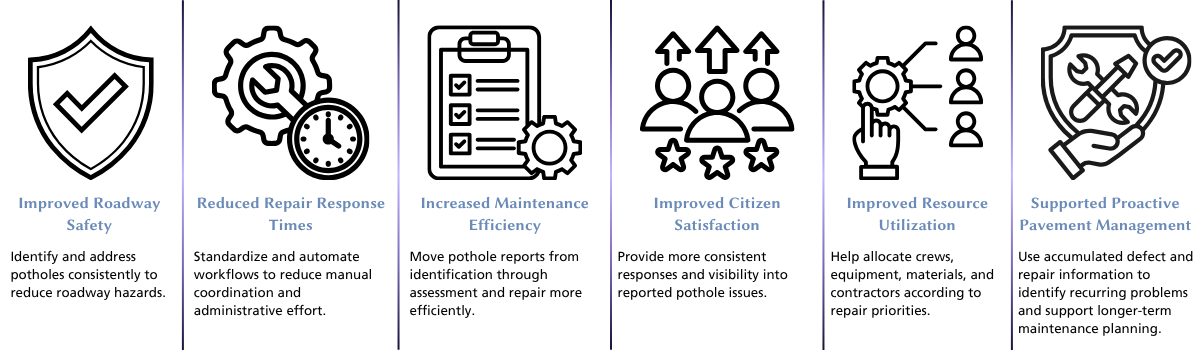
Outcomes
Who Is Involved?
Resident/Reporter → Maintenance Reviewer → Maintenance Approver → Public Works Coordinator/Administrator → Maintenance Crew/Contractor → Resident/Reporter
Actions for Success
How It Works
Submit → Validate → Review → Decide → Assign → Repair → Record → Notify
Step 1 - Submit
The resident, 311 agent, field worker, inspector, or municipal staff member submits or records a pothole report that includes the location, description, photos, and other relevant information.
Step 2 - Validate
The system checks the submission for required information and identifies whether the pothole has already been reported or recorded.
Decision: Is the report complete and actionable?
→ Yes: Continue to Review
→ No: Request additional information or route for field verification before proceeding.
Exception Handling →
Incomplete Report? → The system identifies missing information and requests completion or initiates a field assessment.
Duplicate Report? → A potential duplicate is identified and linked to an existing report or work order rather than creating multiple active requests.
Step 3 - Review
The appropriate maintenance staff member reviews the report, location, photos, conditions, severity, roadway classification, and any available asset or maintenance information.
Exception Handling →
Additional Assessment Required? → The report is assigned for field inspection or additional information before a repair decision is made.
Step 4 - Decide
The municipality determines the appropriate response based on severity, safety risk, service standards, repair requirements, and available resources.
Decision: Does the pothole require municipal repair?
→ Yes: Continue to prioritization and work order assignment.
→ No: Close, defer, monitor, or route to the responsible party as appropriate.
Decision: Does the pothole require immediate or priority response?
→Yes: Escalate according to municipal emergency or priority maintenance procedures.
→ No: Continue through the standard maintenance workflow.
Exception Handling →
Third-Party Responsibility → If the municipality isn't responsible for the roadway or defect, route the request to the appropriate authority or organization.
Temporary Mitigation Required → Where immediate permanent repair is not possible, temporary measures can be recorded and follow-up work scheduled.
Step 5 - Assign
A word order is created or updated with the repair requirements and assigned to the appropriate maintenance crew or contractor. The assignment can consider location, priority, crew availability, equipment, materials, skills, service area, and contractor responsibility.
Decision: Can the repair be completed with available resources?
→ Yes: Schedule and assign the repair.
→ No: Place the work into the appropriate queue, escalate, or assign an external contractor.
Exception Handling →
Resource Unavailable? → The work order remains active and is prioritized for assignment when the required crew, equipment, or materials become available.
Step 6 - Repair
The assigned maintenance crew or contractor completes the repair and records the work performed, materials used, equipment, labour, photos, and completion information.
Decision: Was the repair completed successfully?
→ Yes: Continue to record and close the work order.
→ No: Return to work order for additional work or follow-up.
Exception Handling →
Additional Repair Required → The work order remains active, or a follow-up work order is created to address the remaining issue.
Weather/Site Conditions Prevent Repair → Record the reason, apply temporary mitigation where appropriate, and reschedule the repair.
Step 7 - Record
The completed work, repair details, costs, photos, verification, and relevant communications are recorded in the maintenance history.
Decision: Does the repair require verification?
→ Yes: Route for supervisor or field verification before closure.
→ No: Close the work order according to municipal procedures.
Step 8 - Notify
The resident or reporter, along with relevant internal participants, receives the appropriate status or completion notification. Where applicable, the system communicates the repair status through the original reporting channel.
Other exceptions:
- Emergency Hazard - immediate escalation and dispatch.
- Duplicate Report - link to the existing pothole/work order rather than creating a duplicate work.
- Private/Third-Party Responsibility - route the issue to the appropriate responsible organization.
- Insufficient Information - request additional details or conduct a field assessment.
- Weather/Seasonal Constraint - place work into an appropriate queue or temporary mitigation workflow.
- Unable to Repair - record reason, mitigation, and required follow-up.
- Repeat Failure - flag for inspection, underlying infrastructure assessment, or rehabilitation planning.
What It Enables
Capabilities
- Pothole Reporting - Capture pothole reports from residents, staff, inspections, and connected systems.
- Defect Assessment - Record condition, severity, location, safety considerations, and repair requirements.
- Work Prioritization - Apply rules to prioritize repairs according to severity, risk, roadway classification, service standards, and operational requirements.
- Work Order Management - Convert validated defects into trackable maintenance work orders.
- Crew & Contractor Assignment - Route work to the appropriate internal crew, department, or external contractor.
- Maintenance Scheduling - Schedule repairs based on priority, resources, workload, materials, and operational conditions.
- Field Repair Tracking - Enable crews to receive, update, and complete work while recording field information.
- Repair Verification - Confirm that the repair was completed appropriately before closing the work order.
- Maintenance History - Maintain a persistent history of reported defects, repairs, labour, materials, and outcomes.
- Service Request Communication - Keep residents and other stakeholders informed of report status and completion where appropriate.
Key Features
- Capture reports from multiple sources
- Associate defects and work orders with precise roadway locations
- Attach images and supporting information
- Classify defects and determine repair urgency
- Turn validated reports into actionable maintenance jobs
- Route work to the right source
- Organize repairs according to priority and capacity
- Record materials, labour, equipment, photos, and completion details
- Provide updates to reporters and internal stakeholders
Results
Operational
- Faster movement from report to work order
- More consistent prioritization of repairs
- Reduced duplicate work
- Better visibility into outstanding repairs
- Improved crew utilization
- More complete repair documentation
- Clearer maintenance backlog
- Better coordination between public-facing service teams and Public Works
Users
- Easier reporting for residents with more consistent communication
- Fewer manual follow-ups with Public Works for customer service
- Clear work assignments for maintenance staff
- Better access to location and repair information for staff
- Better visibility into workloads, priorities, and outstanding repairs for supervisors
Organizational
- Stronger accountability for roadway maintenance
- Improved maintenance planning
- Better utilization of municipal resources
- More defensible maintenance records
- Better understanding of recurring roadway defects
- Stronger connection between day-to-day maintenance and long-term asset management
Measures/KPIs
- Average time from report to assessment
- Average time from validated report to repair
- Percentage of priority repairs completed within the service standard
- Open potholes/outstanding work orders
- First-time repair completion date
- Repeat pothole rate
- Cost per repair
- Work orders completed per crew/period
Where Else Can It Be Used?
Example Deployments
Municipal Public Works
Centralize pothole reporting and maintenance across roads managed by a municipality.
Roadway Inspection Programs
Turn field inspection findings directly into prioritized maintenance workflows.
Winter Damage Programs
Manage spring pothole surges following freeze-thaw cycles and winter road damage.
Regional/County Road Networks
Coordinate pothole repairs across geographically distributed road networks and maintenance crews.
Transportation Agencies
Manage roadway defects across larger transportation networks with multiple maintenance teams or contractors.
Private Road/Campus Operations
Manage roadway maintenance across universities, hospitals, industrial campuses, airports, or large private properties.
Contracted Road Maintenance
Coordinate defect identification, contractor assignment, repair verification, and service-level compliance.
Resources
Pothole Repair Management - Infographic
Pothole Repair Management - One Pager
Pothole Repair Management Pricing Page - One Pager
Double-click on the video thumbnail to view in fullscreen.
Frequently Asked Questions
Pothole repair management is one of the many use cases offered in our maintenance & work order management product. This use case streamlines the identification, tracking, prioritization, dispatch, and repair of postholes in municipal road networks. When these operations are streamlined, public works departments will, in turn, be able to improve response times, road safety, and much more.
SimplyCast's Pothole Repair Management use case applies many features that all work together to optimize management. Here are the core features:
- Pothole reporting
- Work order management
- Dispatch & crew coordination
- Mobile field operations
- Repair tracking
- Citizen communications
- Analytics & reporting
Using landing pages lets you create a portal page where residents can access the form to submit reports. The 360 campaign provides a space for all residents to submit maintenance requests and attach key information, such as images and locations. Residents can easily submit reports on their mobile devices and attach key details or images.
All communications with residents are managed through SimplyCast 360. Residents will receive automatic confirmation of the report, status updates, completion notifications, and satisfaction surveys to ensure prompt, consistent communication throughout the process.
- Faster response times: Quickly notify the appropriate teams when potholes are reported.
- Improved coordination: Keep maintenance teams, supervisors, and other stakeholders informed throughout the repair process.
- Streamlined workflows: Automate notifications, assignments, follow-ups, and status updates.
- Better visibility: Track pothole reports and repair progress in real time.
- Improved public service: Resolve road hazards faster and keep residents informed about reported issues.
- Increased efficiency: Reduce manual processes and administrative work for municipal staff.